Why Earn a Bachelor of Science in Mechanical Engineering at Indiana State?
In the Mechanical Engineering BSE (Bachelor of Science in Engineering) program at Indiana State University, you will build a strong foundation in mathematics, science, and core mechanical engineering principles while applying what you learn to real-world problems in the lab and beyond.
You’ll study in an engineering program that supports the full Professional Engineer (PE) licensure pathway, beginning with preparation for the Fundamentals of Engineering (FE) exam. That’s a big advantage if you want a credential that can open doors to greater responsibility, leadership, and long-term career growth.
Indiana is a state known for advanced manufacturing, automotive, aerospace, energy, and logistics. Indiana State connects your coursework to an economy that needs mechanical engineers now and in the decades ahead.
You’ll learn on our campus in Terre Haute, Indiana, in small classes led by expert faculty who will know your name, notice your progress, and help you stay on track toward your goals.
Learn from Our Excellent Faculty
At Indiana State, you’ll learn in small classes from faculty who combine strong academic credentials with real-world engineering experience in areas such as manufacturing, aerospace, energy, and product design.
As part of the Department of Applied Engineering and Technology Management, your professors are committed to teaching first, and they’ll mentor you through coursework, research, internships, and preparation for the FE exam and PE licensure. With small class sizes and a close-knit learning community, you can expect individualized support, helpful feedback, and guidance as you build confidence and define your next steps.
Enrich Your Learning
As a mechanical engineering major, you’ll spend much of your time in the John T. Myers Technology Center and Technology Annex, home to more than 20 state-of-the-art laboratories dedicated to engineering and technology. Here, you’ll use the same tools and technologies practicing engineers depend on every day.
You’ll work in specialized spaces such as the solid modeling and CAD labs, instrumentation and data acquisition labs, and materials testing facilities, where you’ll design 3D models, build and test prototypes, collect and analyze engineering data, and evaluate how materials perform under stress. These hands-on experiences help you connect theory to practice and build confidence in your skills long before you graduate.
Beyond coursework and applied research, you can plug into activities and organizations that help you build community, leadership, and professional connections. These include the American Society of Civil Engineers (ASCE); the American Society of Mechanical Engineers (ASME); the American Institute of Steel Construction (AISC); the Construction Specifications Institute (CSI); and Epsilon Pi Tau (the international honorary for professions in technology).
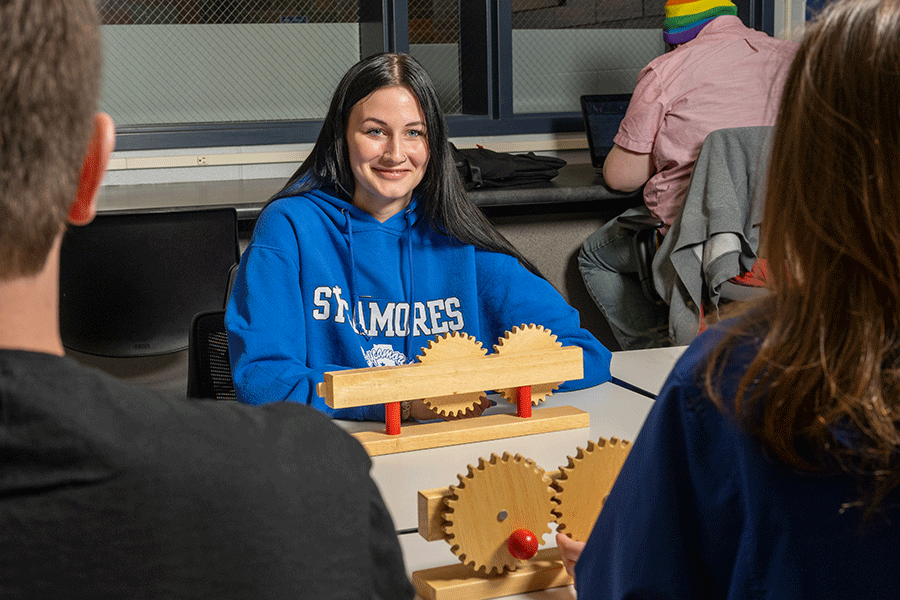
What You’ll Learn in the Mechanical Engineering BSE Program
As a mechanical engineering major, you’ll explore how things move, how energy is converted, and how complex systems are designed—from engines and robotics to renewable energy systems and advanced manufacturing processes.
The Mechanical Engineering BSE at Indiana State University prepares you with the analytical, design, and hands-on skills needed to excel in mechanical engineering roles across manufacturing, automotive, aerospace, energy, medical devices, robotics, and related industries.
You will complete a solid foundation in calculus, statistics, physics, and chemistry. This is followed by core mechanical engineering courses in:
- Statics
- Dynamics and Thermodynamics
- Fluid Mechanics
- Heat Transfer
- Strength of Materials
- Machinery Dynamics
- Finite element analysis.
The Mechanical Engineering curriculum integrates solid modeling and CAD, materials and manufacturing processes, instrumentation and data acquisition, applied computer science in engineering, and engineering economics with team-based projects and a senior capstone design experience.
Mechanical Engineering at Indiana State aligns with national expectations for engineering education and explicitly supports the Professional Engineer (PE) licensure pathway. Located in one of the nation’s leading manufacturing states, the program connects classroom learning and laboratory work to the real needs of Indiana’s advanced manufacturing, logistics, and technology economy.
Transfer Credit
Indiana State University accepts credit from regionally accredited colleges and universities within the United States, and from selected schools located outside the United States. Credit also may be granted for military training and experience. Previously earned college credit can be applied toward completion of the program per Indiana State’s transfer guidelines.
Career Possibilities for Mechanical Engineering Majors
Earning a Mechanical Engineering BSE from Indiana State gives you a clear, structured pathway to Professional Engineer (PE) licensure. This is a significant credential that opens doors to greater responsibility, document-signing authority, and leadership roles in engineering practice.
The typical pathway includes passing the Fundamentals of Engineering (FE) exam, gaining four years of relevant work experience, and passing the Principles and Practice of Engineering (PE) exam. All are governed in this state by the Indiana Professional Licensing Agency and administered for mechanical engineering by the National Council of Examiners for Engineering and Surveying (NCEES).
Mechanical engineering careers span sectors that include advanced manufacturing, aerospace and defense, automotive, energy, medical devices, robotics and automation, engineering consulting, and government agencies. Graduates are prepared for engineering roles in these industries including:
- Design Engineer
- Manufacturing Engineer
- Project Engineer
- Development Engineer
- Maintenance Engineer
- Mechanical Engineer
- Automotive Systems Engineer
- Energy Systems Engineer
- Fuel Cell Engineer
- Wind or Solar Energy Systems Engineer
- Mechatronics Engineer
- Robotics Engineer
According to the U.S. Bureau of Labor Statistics, employment for mechanical engineers is projected to grow about 9% nationally through 2034, adding more than 26,500 new jobs and far outpacing average job growth. In Indiana, projections indicate more than 1,200 new mechanical engineering positions and related roles will be added by 2034, driven by the state’s strong manufacturing, logistics, and advanced industry sectors. Nationally, median pay for mechanical engineers was nearly $100,000 in 2024.
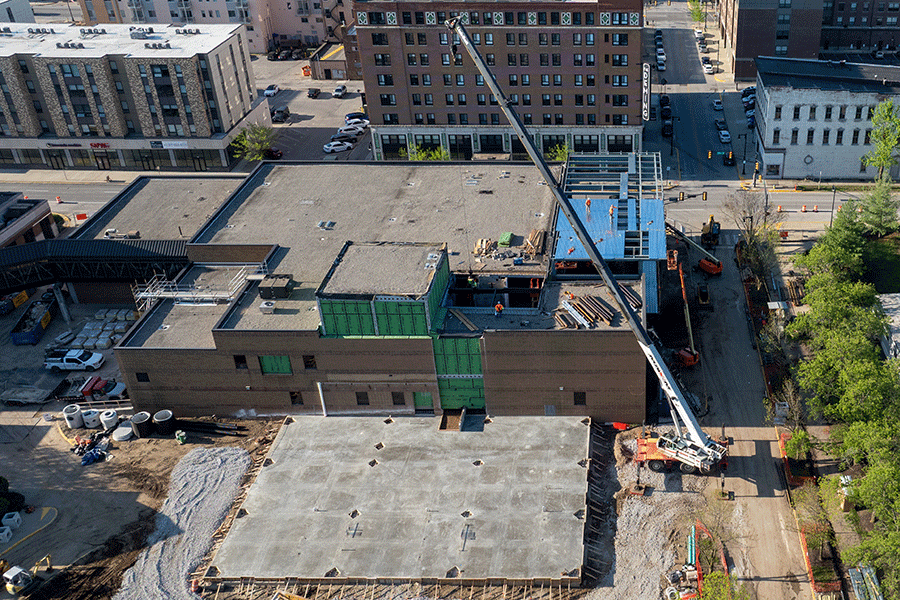
Indiana State expands Engineering & Technology footprint, resources
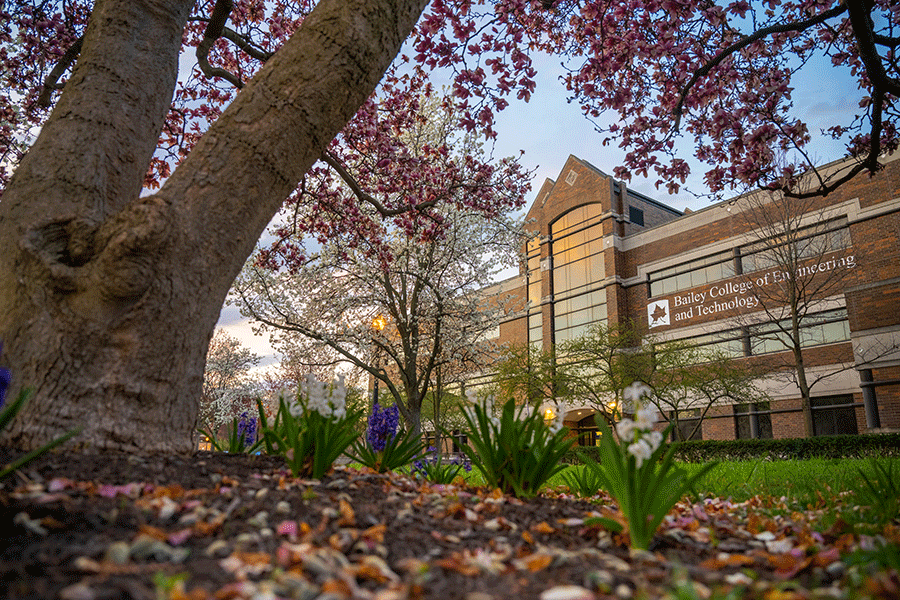
Indiana State University is in the midst of a $66 million, state-supported renovation of its Technology Annex for the Bailey College of Engineering & Technology. This project, scheduled to be completed in 2027, represents a significant investment in the College’s students and in the labs, classrooms, and other learning spaces that support their work.
Learn more about the Bailey College renovation project.
-

Civil Engineering (BSE)
Bachelor's
-
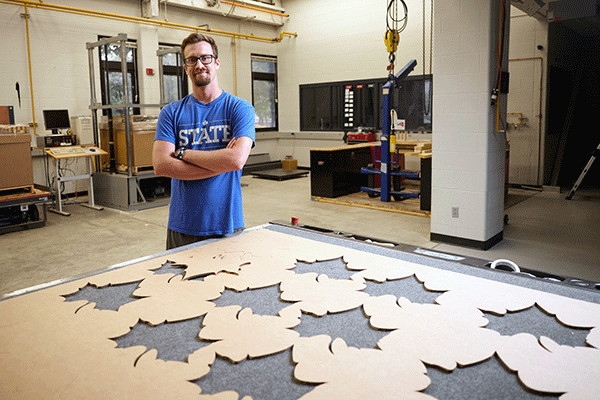
Packaging Engineering Technology (BS)
Bachelor's
-
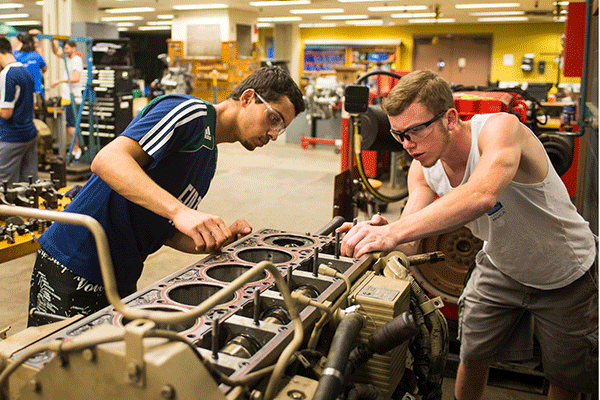
Automotive Engineering Technology (BS)
Bachelor's