Why Earn a Bachelor's Degree in Safety, Health, and Environment at Indiana State?
Few fields offer the combination of stability, purpose, and opportunity you will find in workplace safety and environment professions. Companies across manufacturing, healthcare, energy, government, logistics, and many other industries need qualified professionals to help reduce workplace risk, protect their employees, and support regulatory compliance.
The Bachelor of Science in Safety, Health, and Environment at Indiana State University is one of the first degree programs of its kind in Indiana and one of the earliest such programs in the nation. It combines course flexibility with opportunities for on-site industry experience.
Indiana State offers one of the few ABET-accredited, undergraduate occupational safety degrees that may be completed online as well as on campus. Either way, you will fulfill an internship requirement (the majority of these are paid internships) and work toward valuable industry credentials as part of this program.
Additionally, students may qualify to pursue the Occupational Safety Management Accelerated Master of Science. This 4+1 program allows you to begin working toward your graduate degree during your senior year of undergrad and complete the two-year master's program with just one additional year of study.



Learn From Faculty With Industry Experience
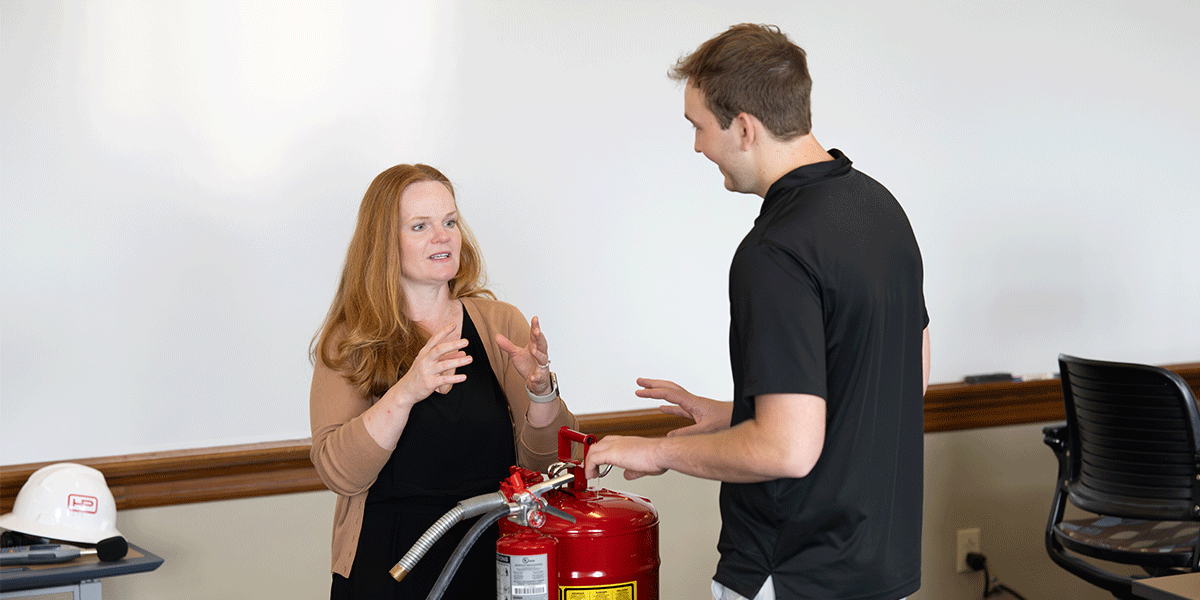
Small classes create opportunities for meaningful interaction with professors who bring industry knowledge and professional experience into their classrooms. They understand how safety, health, and environmental principles are applied in the field, and they connect those real-world practices to your coursework.
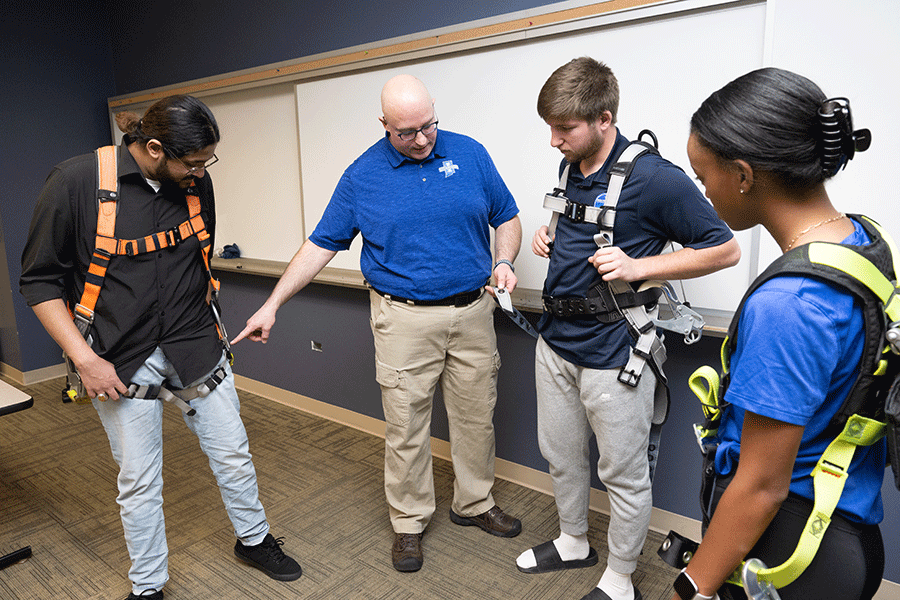
In the Safety, Health, and Environment degree program, you’ll receive personalized feedback and mentorship from your instructors as you undertake hands-on projects and prepare for immersive internship experiences. Faculty may also invite you to participate in research and applied projects that further qualify you for career and credentialing opportunities.
Build Skills in Advanced Learning Environments
Safety professionals solve problems in real work spaces, not just textbooks. That’s why hands-on exposure is incorporated throughout the Safety, Health, and Environment curriculum.
At Indiana State University, you’ll gain practical experience in an industrial hygiene laboratory equipped with technology, instrumentation, and software that is used to evaluate occupational exposures and workplace hazards. Working with the same tools used by professionals in the field, you will develop confidence, strengthen technical skill sets, and prepare yourself to perform at a high level in live work environments.
Connect With Other Students and Industry Professionals
As a Safety, Health, and Environment major, you will have the opportunity to join the American Society of Safety Professionals (ASSP), Student Section. This participation enables you to qualify for scholarships worth thousands of dollars. Indiana State students have traditionally received the highest percentage of ASSP scholarships available to programs across the country.
What You'll Learn in the Safety, Health, and Environment Program
Creating safer workplaces takes more than reading and understanding regulations. It requires the ability to recognize and anticipate hazards, analyze risk, communicate concerns and findings effectively, and make informed decisions that protect people, operations, and the environment.
The Safety, Health, and Environment bachelor's program provides a broad foundation in these areas while helping you develop the scientific, technical, and management skills needed for long-term career growth. Through rigorous coursework, extensive laboratory experiences, and a paid industry internship, you’ll learn to evaluate challenges and implement practical solutions as a knowledgeable health and safety professional.
Coursework covers such topics as:
- Hazard identification, risk evaluation, and hazard control strategies
- Industrial hygiene principles and occupational exposure assessment
- Fire protection systems and hazardous materials operations
- Occupational toxicology and human factors/ergonomics
- Safety legislation, program administration, and workforce training
- Disaster preparedness, sustainability, and resilience engineering
- Supporting studies in science, mathematics, management, and communication
- A professional field practice internship that provides real-world experience
Internships and Employer Partners
Before graduation, you will complete a required internship in which you’ll apply what you’ve learned in a live employer setting.
Students typically complete internships in manufacturing, healthcare, energy production, refinery operations, insurance, and government agencies. Past employer partners have included Alcoa, Cargill, Eli Lilly, General Electric, Pfizer, Cummins, and Toyota.
These experiences foster practical engagement with the profession that helps you build confidence, grow your network, and hone the technical skills employers expect from new hires.
Transfer Credit
Indiana State University accepts credit from regionally accredited colleges and universities within the United States, and from selected schools located outside the United States. Credit also may be granted for military training and experience. Previously earned college credit can be applied toward completion of the program per Indiana State's transfer guidelines.
Transfer GuidelinesRecognitions and Designations
The Bachelor of Science in Safety, Health, and Environment program is recognized as a Qualified Academic Program (QAP) by the Board of Certified Safety Professionals. This designation allows our graduates to apply for the Graduate Safety Practitioner (GSP), which puts you one step closer to your Certified Safety Professional (CSP) certification.
The Institute of Hazardous Materials Management's Student Associate Safety & Health Manager (ST/ASHM™) credential recognizes students who wish to demonstrate their development of knowledge and skills in safety and health management in the workplace while pursuing their undergraduate or graduate degree. Student ASHMs are also eligible for the IHMM Dr. John H. Frick Memorial Scholarship, a $32,000 program to assist our student certificants with the costs of their education.
After Your Student ASHM designation, You Earn Your Associate Safety & Health Manager [ASHM] designation along with your degree.
IHMM’s Associate Safety and Health Manager (ASHM™) credential recognizes professionals who are recent bachelor’s degree graduates with a focus in health- and safety-related fields. This credential puts the holder on the fast-track to the Certified Safety and Health Manager (CSHM®) credential.

Indiana State expands Engineering & Technology footprint, resources
Indiana State University is in the midst of a $66 million, state-supported renovation of its Technology Annex for the Bailey College of Engineering & Technology. This project, scheduled to be completed in 2027, represents a significant investment in the College’s students and in the labs, classrooms, and other learning spaces that support their work.
Learn more about the Bailey College renovation project.Career Possibilities for Safety, Health, and Environment graduates
Safety, health, and environment professionals work in nearly every industry because every organization benefits from reducing risk and protecting people. Our graduates may pursue careers as specialists, managers, and consultants in:
- Environmental Health and Safety
- Occupational Health
- Industrial Hygiene
- Fire/EMS
- Construction
- Engineering
- Manufacturing
- Government/Public Sector
Many graduates enter the workforce immediately, while others continue their education with graduate study and advanced professional certifications. Indiana State University offers a Master of Science in Occupational Safety Management for students interested in advancing their knowledge and employability in the field.
Accreditation
Indiana State University is accredited by the Higher Learning Commission.
The Safety, Health, and Environment program (formerly the Safety Management program) at Indiana State University was one of the first to offer a bachelor's degree in the United States. The Safety, Health, and Environment undergraduate degree program is accredited by the Applied and Natural Science Accreditation Commission (ANSAC) of the Accreditation Board for Engineering and Technology (ABET). https://www.abet.org
* 415 N. Charles Street, Baltimore, MD 21201, (410) 347-7700
Program Educational Objectives (PEOs)
Below are the Program Educational Objectives (PEOs) that describe what graduates are expected to attain within a few years of graduation:
PEO 1 - Demonstrate knowledge and skills in the area of safety management;
PEO 2 - Communicate safety-related topics (orally and in writing) and work effectively both independently and in teams;
PEO 3 - Continue education and professional development; and
PEO 4 - Demonstrate ethical, social, and professional responsibility.
Student Outcomes (SOs)
Below are the Student Outcomes (SOs) that describe what graduates are expected to attain by the time of graduation:
(1) An ability to identify, formulate, and solve broadly defined technical or scientific problems by applying knowledge of mathematics and science and/or technical topics to areas relevant to the discipline;
(2) An ability to formulate or design a system, process, procedure or program to meet desired needs;
(3) An ability to develop and conduct experiments or test hypotheses, analyze and interpret data and use scientific judgment to draw conclusions;
(4) An ability to communicate effectively with a range of audiences;
(5) An ability to understand ethical and professional responsibilities and the impact of technical and/or scientific solutions in global, economic, environmental, and societal contexts; and
(6) An ability to function effectively on teams that establish goals, plan tasks, meet deadlines, and analyze risk and uncertainty.
Related Programs
-

Construction Management (BS)
Bachelor's
-

Supply Chain Management (BS)
Bachelor's
-
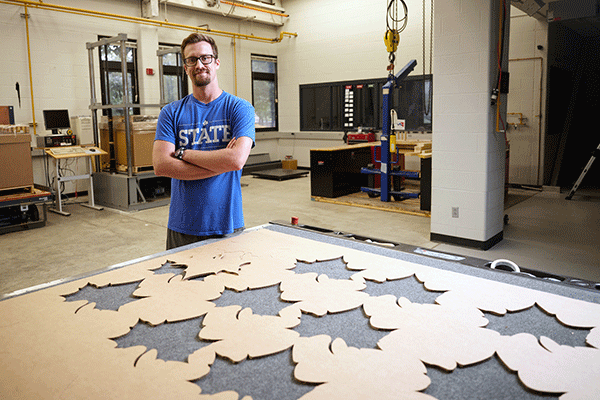
Packaging Engineering Technology (BS)
Bachelor's