Sycamore Summer Scholars

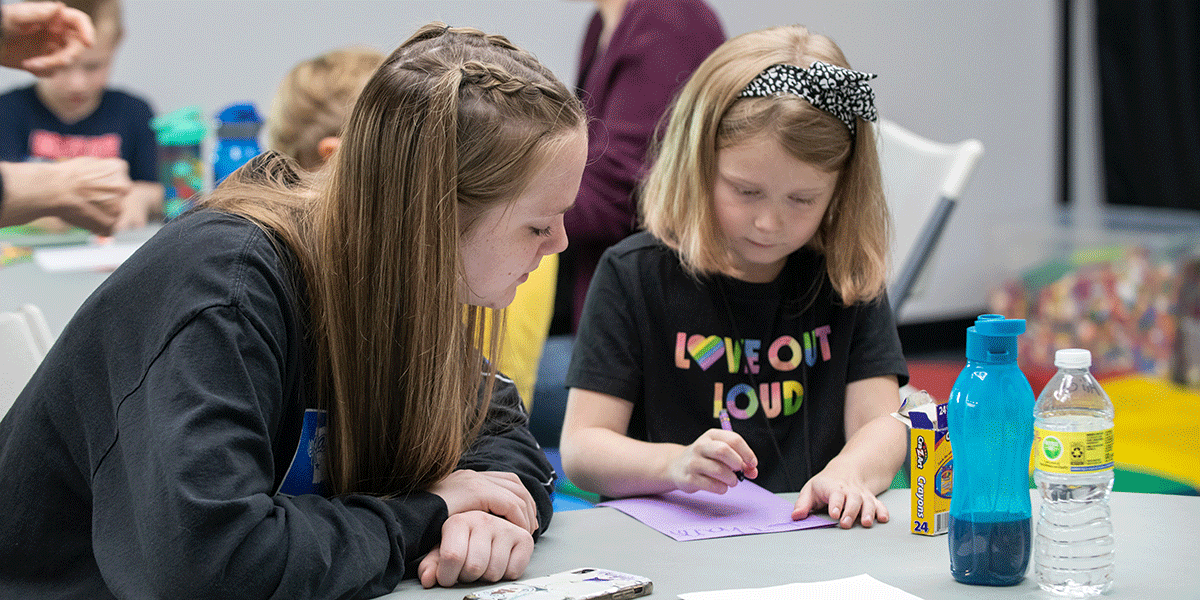
Sycamore Summer Scholars is a residential academic program in which high school students stay on campus at Indiana State, explore an academic major, and earn college credit. All seminars are held on Indiana State’s campus in Terre Haute, Indiana.

Join Us This Summer!

High school students graduating in 2027 and 2028 are invited to participate in Sycamore Summer Scholars, a residential academic program allowing high school students to explore an academic major, experience campus life, and earn University credit at Indiana State. Offered in a 5-day seminar, Sycamore Summer Scholars will be held July 7 to 11, 2026. Applications will open on February 2nd.

Discover the right major for your academic interests. Engage in college-level coursework, including challenging seminars in a variety of disciplines. Experience what it’s like to live on a college campus. Meet, mingle, and make new friends.

Throughout 50 years of service, Sycamore Summer Scholars has welcomed more than 14,000 high school students to campus. Your Sycamore experience begins over the summer. Learn more about Sycamore Summer Scholars and apply for your favorite program today.

Remote video URL

Students with a 2.4 gpa can sign up for UC classes and those with a 3.0 can choose between GH or UC seminars. 

Seminars UC 110

Description: Discover the impact you can make through the social work profession in this dynamic and interactive seminar! This engaging course introduces students to the social work profession through a blend of classroom lectures, meaningful discussions, and real-world experiences. Students will go beyond the classroom with field trips to local social service agencies, gaining firsthand insight into how social workers serve individuals, families, and communities. Hands-on learning activities are woven throughout the seminar to reinforce key concepts, encourage critical thinking, and bring theory to life. Whether you are exploring a future career or simply curious about helping professions, this seminar offers an engaging introduction to the vital role of social work in society!

Field trip: Terre Haute Boys and Girls Club, Susie's Place.

Student packing list: Standard packing list, including comfortable shoes.

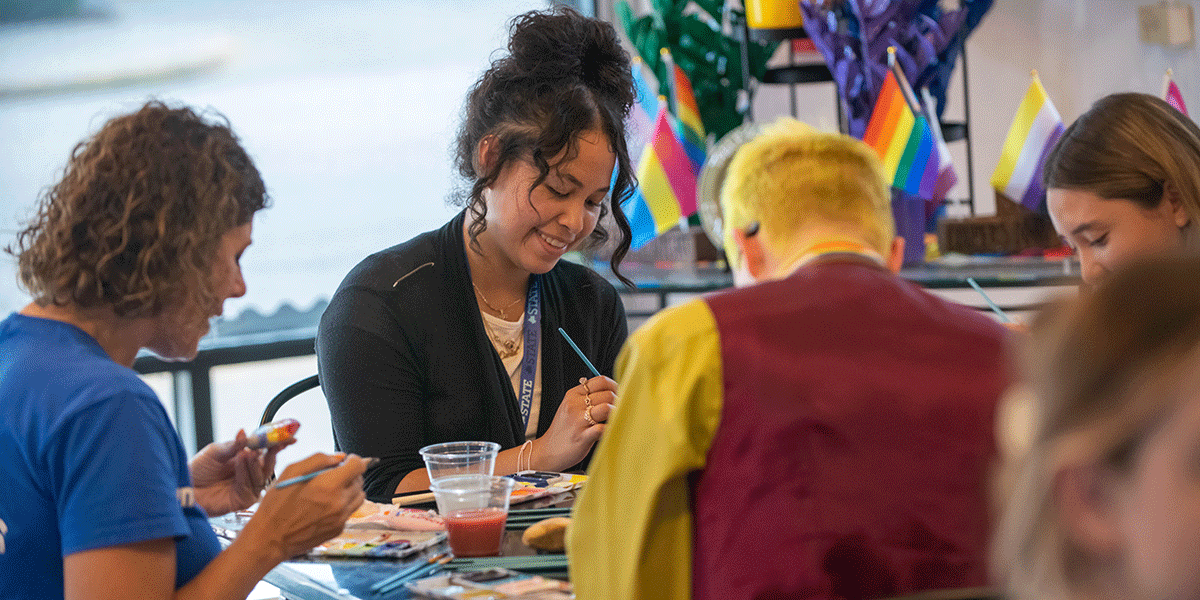
Description: This seminar will allow students a hands on experiences with different media. Print making: design, carving, inking and printing. Painting on canvas with brush and paints creating texture, line, shape, color. Drawing with colored pencil and still life, creating highlights midtones, reflected light and shadows on forms. Sculpture will be forming shapes out of clay and tools. The mural will be created bv students collaboratively working on individual pieces (with collage that will be lined up together to form the large image.
These art works will be displayed on Saturday for friends and family to see before students take them home.

Student packing list: Sketch book, old magazines, favorite pencils, brushes, and tools.

Description: World Politics and Popular Culture invites students to explore the role that popular culture (music, movies, tv shows, etc.) plays in both framing and reflecting our socio-political realities. We engage with popular culture daily in various forms and it is often the most frequent form of information/entertainment we consume. Yet, at the same time popular culture is deemed frivolous or "just" entertainment. This course shows how these two worlds intersect and makes world politics an issue that is much more prevalent in day to day life than students would expect. At the end of the course, students will not only engage with popular culture goods but they will get a better grasp of world politics issues, processes, and systems. 

Student packing list: Laptop, headphones, pen and paper. 

Description: This course aims to prepare the incoming students for how they can become college students, not just in name, but in the ways of higher levels of thinking. The main objectives are going to focus on the way for the students to communicate and act with their professors, peers, and all the different types of people they will interact with as they become college students from freshman to senior year. The last main objective will be writing-based. The students will write a small analysis of a song to try and find a deeper meaning. This will be to show the higher level of thinking and then they will interact with their peers to review their work and communicate what they tried to do with their writing. 

Student packing list: The only items the students will need are pens, a notebook, and an open mind to have discussions with their peers.

Description: The primary objective of this seminar is to prepare students to be successful as collegiate music majors. An introduction to the core components of music is critical to students’ success in music. Daily activities will include lessons in basic theory concepts, historical perspectives, sight-singing, listening exercises, as well as individual and group performance opportunities. 

Student packing list: Spiral notebook and writing utensils. Sheet music will be provided.

Description: This high-quality program will provide participants with hands-on activities that will help students learn how to learn. During the five-day seminar, students will learn and apply effective learning strategies as well as evaluate and adjust personal study habits. Through the various activities, students will be exposed to strategies and thinking frameworks to aid in the development of a growth mindset that is needed to overcome academic challenges. 

Student packing list: Students should bring a computer for this course.

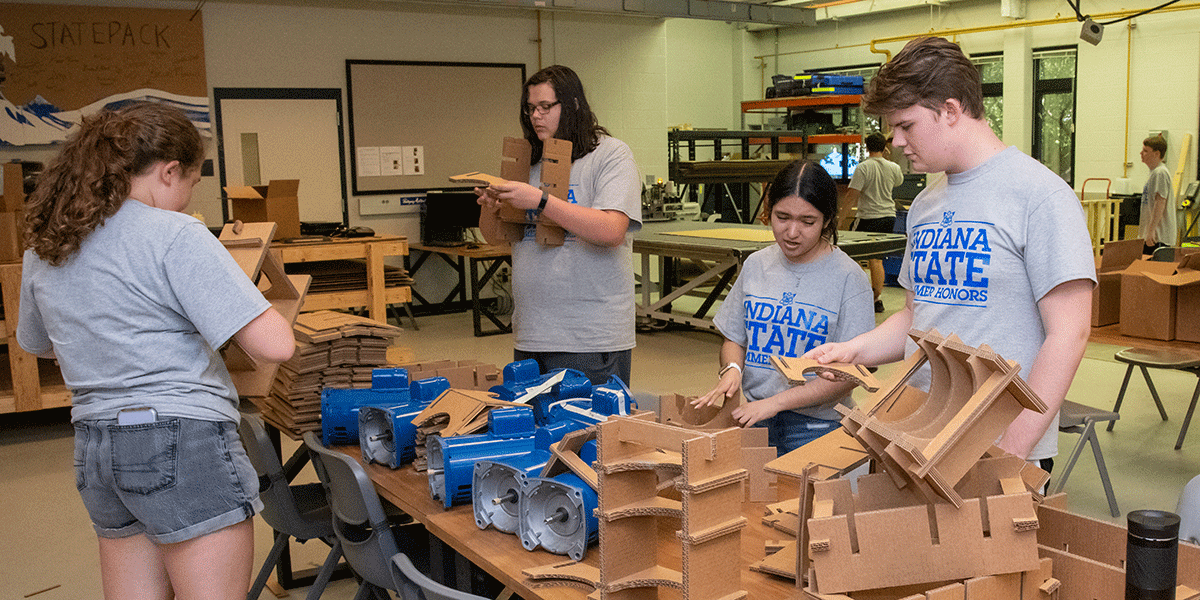
Description: Packaging is everywhere, essential to every company and brand. It drives a U.S. industry valued at over $200 billion. Indiana State University offers the ONLY Packaging degree in Indiana and one of 8 total nationwide. Graduates enjoy 100% job placement, with more careers available than candidates, highly competitive starting salaries, and strong career satisfaction in an innovative field. In this seminar, explore packaging through hands-on labs: design, build, and test prototypes in our dedicated facilities, gaining skills for a rewarding future.

Field trip: Indianapolis, IN to visit a corrugated manufacturer. 

Student packing list: Laptop, tablet, or phone (required for design software and activities; campus devices available as backup).
Closed-toe shoes (required for laboratory safety).
Safety glasses and hearing protection (optional; provided by the program).

Description: Get ready to step into the world of real forensic science! In this seminar, you’ll explore how experts use anatomy and physiology to uncover the hidden stories inside prosected human cadavers. When a cadaver arrives at a lab, we usually only know the basics—how they died, their age, and what they did for work. But their body can reveal so much more about how they lived!

You’ll learn the essentials of how the cardiovascular, respiratory, and urinary systems work, and then use that knowledge to investigate real anatomical clues. By examining actual pathological findings, you’ll piece together details about a person’s life—just like a forensic investigator. It’s hands-on, scientific, and eye‑opening!

Student packing list: Closed-toe shoes and pants - NO shorts, flip flops, sandals, or crocs.

Description: “History Through Disney” is designed to encourage students think about “big” topics in history through the lens of our beloved “Disney,” both Walt, the man who started the Disney empire of course, and the Disney Studios and Corporation.  Populism, The Age of Invention, Business Growth and Monopoly, Labor Unions and Labor Controversy, the Great Depression, the Cold War, the Rise of American Conservatism, Gender Roles and the Nuclear Family, American Imperialism:   Disney was and is at the center of them all.  Some argue that Disney has, for most of the twentieth and now into the 21st century, provided the very cultural framework through which we understand everything from sports, to gender, race, ideas about what constitutes “entertainment,” work, even our understanding of history.  Throughout the week, we will examine the extent to which this is the case and, if so, how it happened! 

Student packing list: Pocket money, a backpack.

Description: Turn your passion for the environment into real change. In Eco-Impact Lab: Environmental Economics in Action, you will spend five days on the Indiana State University campus exploring how economics and science combine to tackle environmental challenges. Visit Wabashiki and the ISU recycling center, heating plant, packaging lab, and community garden; meet faculty, staff, students, and local activists working on sustainability. In small teams, you will design and present a project that proposes a realistic change for campus or the community while earning college credit. 

Field trip: Wabashiki area in West Terre Haute, IN.

Student packing list

  • Comfortable, closed-toe walking shoes (required field experiences).
  • Weather-appropriate clothing for outdoor activities (hat, sunscreen, or rain jacket as needed).
  • Refillable water bottle.
  • Small notebook and pen/pencil for field notes.

Description: This seminar will focus on gaming, tournament planning, live streaming content, and social media.  Students will get hands-on experience in the world of Esports.  We will play games on new PCs, as well as plan events and learn how marketing works in the video game industry. 

Seminars - GH 199

Description: What exactly is the law, and how does it affect me? In this course, we will investigate how your rights and liberties impact your everyday lives, what the day-to-day life of a lawyer is like, and how to have meaningful and constructive debate over important issues. We will visit the Vigo County Courthouse and sit in on a real, live session of Court proceedings, and then have a mock trial in our beautiful Magna Carta Room (yes, Mom and Dad, you are invited!) This course is not restricted to just those who want to be a lawyer, but anyone who is interested about how the law impacts our daily lives.

Field trip: Vigo County Courthouse

Student packing list: They should bring one day of business casual and one day of something closer to business professional, although there is no need for them to go buy something new. 

Description: What is a drug?  Many of us have a vague understanding of this, but not much more.  How do drugs work? Where do they come from? What are the benefits and risks of drugs to people and society? How are drugs developed and marketed?  What are the differences between legal and illegal drugs?  These questions and more will be answered during this ISU Summer Honors course.  In the morning seminar, we will discuss natural and man-made drugs, their chemistry, and how they work in people.  We will learn about a wide range of drugs, including pain killers, antibiotics, and drugs acting on the brain to relieve depression and anxiety or to help us think more clearly.  We will learn about prescription and over-the-counter drugs.   As preparation for the above, a foundation of chemical principles will be provided through discussions and presentations focusing on analytical techniques.  In the midday laboratory, we will conduct experiments that isolate or synthesize a number of compounds discussed in the seminar, as well as analyze their composition.  As part of the laboratory, we will also have a campus field collection trip to collect local plants and extract chemical compounds from them. Please note:   Students enrolling must have completed a high school chemistry course.

Student packing list: Students must wear closed toe shoes and will need a calculator and laptop or computer access for writing an essay and preparing a PowerPoint presentation.  A lab coat and safety glasses will be provided.  Students should bring their smartphones to class.  We will use them for looking things up and taking Kahoot quizzes.

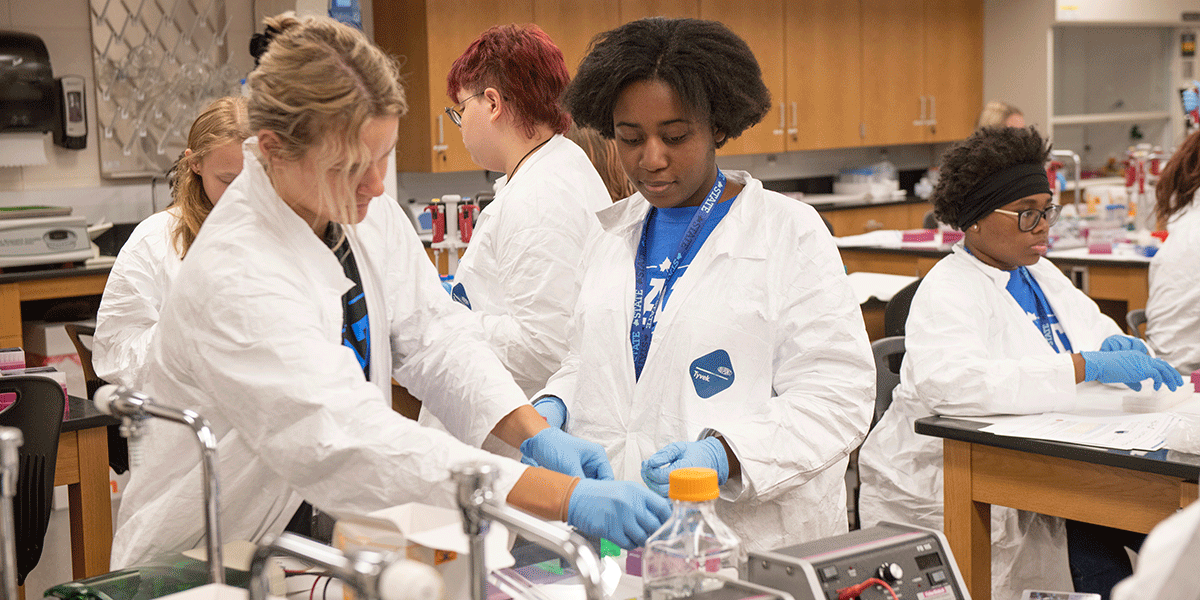
Description: This course will introduce students to the laboratory skills that can lead to careers utilizing genomics, genetics, microbiology, and molecular biology through a combination of learning activities and hands-on medical and biomedical laboratory work. 

Student packing list: Students will be provided personal protective equipment for use in the laboratory. Apparel for laboratory classroom requires no shorts and no open toed shoes. 

Description: This course provides a bridge between academic learning and real-world challenges by partnering with automobile companies and the City of Terre Haute's Sustainable Cities Program. Students will understand customer demand for the electric vehicle (EV) charging station, procurement costs, financial performance, the application of sustainable energy, and transportation routes. Design optimization solutions are presented through analysis techniques in business and supply chain management. 

Field trip: Terre Haute City Hall.

Description: Students will learn about key elements to make communities more resilient, as well as elements of preparedness for, response to, and recovery from disasters. Students will then apply this knowledge in a role-playing simulation where they will be asked to lead a community through a disaster. 

Student packing list: Students should provide pens and a notebook.

Description: Experimental archaeology is one of the most important tools to develop and test models which link human behaviors and natural forces to the archaeological record. It can involve the study of ancient technologies (like making stone tools or smelting copper), replication of subsistence (like butchery) and other practices, and identification of site formation processes (like trampling by animals). In addition to the rigor of a college level course, this seminar provides a hands-on experiential learning experience as students learn how to recreate past technologies. During the week students will be introduced to the fundamentals of experimental archaeology and experimental design. To provide a fully authentic experience, students will participate in research activities for one or more ongoing experimental archaeology projects learning about how tools were made and used in the past. 

Student packing list: Close toed shoes, durable pants; optional - work gloves, eye protection.

Description: This philosophy course uses Season 1 of The Good Place as a serialized philosophical text to explore what it means to be a good person, how moral systems function, and whether moral growth is possible. Students watch each episode (approximately 20 minutes), followed by a short philosophical reading and structured discussion. Each episode is paired with a specific philosopher while centering one moral question. Class participation will be encouraged through individual thought experiments, in-class debates, collaborative projects, creative exercises, role play, etc. 

The Good Place teaches philosophy by turning abstract moral questions into lived, relatable experiences, while using humor to make those ideas accessible rather than intimidating. (One of the characters—Chidi—is a Philosophy professor and teaches some of the philosophers we will learn about in this course!) Instead of presenting ethics as a set of rigid rules or dense theories, the show embeds philosophical concepts—like moral responsibility, intention versus consequence, and the possibility of moral growth—directly into the characters’ struggles and choices. Humor plays a crucial role in this process: jokes, absurd situations, and self-aware commentary lower viewers’ defenses and invite them to engage with difficult ideas. By making us laugh at moral failures, contradictions, and overthinking, The Good Place shows that philosophy is not just an academic exercise but a practical, human endeavor. In doing so, this extremely popular series demonstrates that thoughtful reflection about being good can coexist with joy, humility, and curiosity, making philosophy feel both meaningful and approachable.

A description of each episode of Season 1 of The Good Place can be found here: https://thegoodplace.fandom.com/wiki/Season_1

Student packing list: Notebook or journal.

Description: The “overview effect” is a concept coined by the philosopher Frank White in 1987 to describe the experience many astronauts feel as they look back at planet Earth from space. Astronauts who have been to orbit often describe how seeing our home world from this entirely new perspective fundamentally alters their relationship to Earth, its living systems, and our own species. The experience begins with a profound sense of awe and wonder at the raw beauty of our living world—the only planet in the entire universe where we know that life exists. The “overview effect” then leads to an ever-deeper appreciation of the fundamental interconnectedness of all life on Earth, the extraordinary fragility of our living world, a recognition that humanity is a part of this living system and not separate from it, and finally a powerful sense of responsibility that prompts a corresponding need to care for our environment. 

This interdisciplinary seminar brings together the arts and the sciences in a unique and powerful way by introducing students to the concept of the ““overview effect”,” employing classroom-based individual and group activities to facilitate students’ holistic understanding of the idea and then taking students out of the classroom and into both Nature and the local human community to prompt creative responses to the worlds around us. The students will then organize, as a culminating project, their own demonstration of how they have been individually and collectively affected by the effort to bring the “overview effect” down to earth. Students will be guided in the practice of closely reading both literary and scientific texts published by a wide variety of poets, fiction writers, filmmakers, photographers, journalists, and scientists. The seminar will give students the opportunity to practice writing about their creative and evidence-based readings and then sharing their work with the class daily in reflection review sessions. The culminating student-organized project will be a public showcase of their creative and thoughtful responses to course content and course questions. 

This seminar will study the “overview effect” but most importantly we will explore ways of bringing this sense of awe and wonder, connection and curiosity, down to earth for our use here and now. We will examine poetry, fiction, journalism, photography, film, science writing, and published scientific research to better understand the “overview effect” and our contemporary world defined by anthropogenic (human-caused) climate and ecological crises. We will be guided by the work of writers, artists, scientists, and thinkers such as Emily Dickinson, John Clare, Marianne Moore, Dylan Thomas, W. H. Auden, Elizabeth Bishop, Ted Hughes, Seamus Heaney, Michael Longley, and Amanda Gorman (all poets), Margaret Atwood, Richard Powers, and Samantha Harvey (novelists), David Attenborough and Joel Sartore (filmmakers and photographers), Carl Sagan, Neil de Grasse Tyson, E. O. Wilson, Suzanne Simard, Peter Wohlleben, Lars Chittka, Michael Mann, and Katherine Hayhoe (scientists), and Bill McKibben, Elizabeth Kolbert, and David Wallace Wells (science communicators and journalists). Above all, students be presented with opportunities in and out of the classroom (including at the ISU Community Garden and the local not-for-profit reTHink, which focuses on community-wide sustainability education) to reconnect with the living world around us and to celebrate that world through students’ own creative expression. The seminar will conclude with a student-organized multi-media showcase where students will present their own creative work, be it poetry, storytelling, art, photography, film, or music.

Field Trip: reTHink headquarters.

Student packing list: A spiral notebook for notes and reflection journal entries, pens, pencils, work clothes and shoes that can get dirty, laptop if available.

About the Program

Sycamore Summer Scholars 2026 is open to high school students (in-state and out-of-state) in the graduating classes of 2027 and 2028. High school students must have a 2.4 or higher high school GPA to participate. Students who have completed their senior year, as well as international students who require a visa to study in the United States are not eligible to enroll in the short-term Sycamore Summer Scholars programs. Students with a 3.0 GPA and higher are eligible for the GH 199 and UC 110 seminars. Students with a 2.4 to 2.99 GPA are eligible for the UC 110 seminars.

The Sycamore Summer Scholars 2025 program fee is $500 to $600. This includes all meals, seminar books and supplies, and seminar-sponsored activities.

All Sycamore Summer Scholars 2026 seminars will be held on Indiana State University’s campus in Terre Haute, Indiana and will be held July 7-11, 2026

Students participating in Sycamore Summer Scholars are required to stay on campus for the duration of the week-long program. Students will live in air-conditioned rooms with a roommate inside Pickerl Hall.

Rooms have private bathrooms. Student leaders will reside on each floor. Sycamore Summer Scholars students will have full access to Indiana State’s Student Recreation Center, Hulman Memorial Student Union, and Cunningham Memorial Library during the camp.

Last Day to Apply: May 22, 2026 
Last Day to be admitted: May 29, 2026 
Last Day to select a Seminar: June 9, 2026

Already Admitted?

Access your Sycamore Summer Scholars Portal

The Sycamore Summer Scholars Portal is where you will select your seminar and submit payment, sign required documents, and find packing lists. You will also find information about move in, orientation, and move out. Seminars fill up quick so please select and seminar and process payment as soon as possible. 

Registration for Sycamore Summer Scholars will be available early February 2026.

Contact Us

Office of Admissions
Welcome Center
318 North 6th Street
Terre Haute, IN 47809

Phone: 1-812-237-2121
Email: admissions@indstate.edu