NOTE: The Manufacturing Engineering Technology program has been suspended. It no longer accepts new student applications.
What You’ll Learn in the Manufacturing Engineering Technology Program
As a manufacturing engineering technology major, you will complete coursework in the following areas:
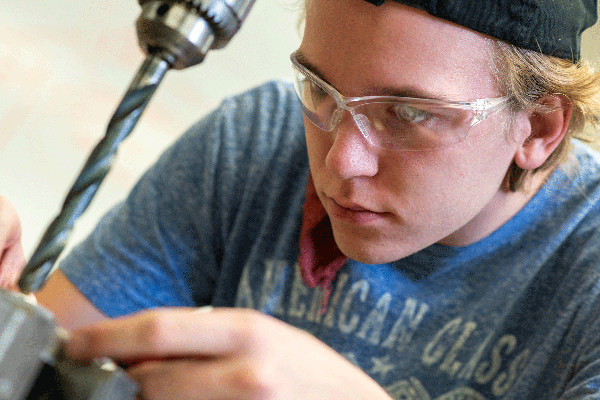
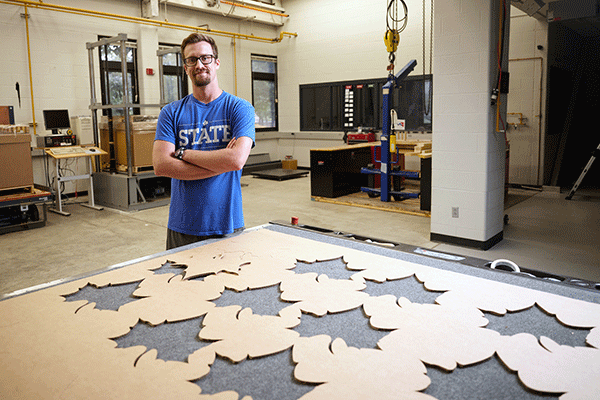
- Manufacturing processes and materials, and computer numerical control systems
- Technology management, including manufacturing, problem-solving, production planning and control, quality control, industrial organizations and functions, and industrial supervision
- Electronics technology, including automation, programmable logic controllers, and robotic controls
- Mechanical engineering technology, including CAD, fluid power, and solid modeling
- Mathematics, computer applications, and graphic analysis
- Accident prevention
You will also gain practical experience through an internship.
Transfer Credit
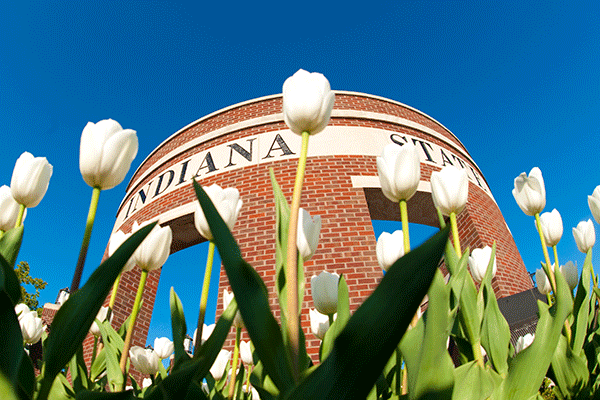
Indiana State University accepts credit from regionally accredited colleges and universities within the United States, and from selected schools located outside the United States. Credit also may be granted for military training and experience. Previously earned college credit can be applied toward completion of the program per Indiana State's transfer guidelines.
Transfer GuidelinesCareer Possibilities for Manufacturing Engineering Technology Majors
Our graduates are well prepared for rewarding careers in manufacturing engineering professions. Alumni from our program have gone on to work for Allison Transmission, Caterpillar, Cummins, General Electric, Honda, Pfizer, Toyota, and Wright Industries, among many other companies.
The Bureau of Labor Statistics projects overall growth of 10% in the field from 2021 to 2031, faster than the average for all occupations.

The Manufacturing Engineering Technology undergraduate program is accredited by the Engineering Technology Accreditation Commission of ABET, http://www.abet.org.
Mission
The mission of the Manufacturing Engineering Technology (MFET) degree program at Indiana State University is to prepare graduates with technical and leadership skills necessary for manufacturing competitiveness and to enter careers in manufacturing process and systems design, operations, quality, continuous improvement, lean manufacturing, and sustainability.
Vision
The Manufacturing Engineering Technology degree program will be a leader in integrating teaching, research, and creative activity in an engaging, challenging, and supportive learning environment preparing productive citizens for Indiana and the world while creating and maintaining a credible presence within the manufacturing sector of education and industry.
Program Educational Objectives (PEOs)
Graduates two to three years into their career should have the foundation to:
- PEO 1 (Technology) - Apply disciplinary reasoning, critical thinking, and hands-on skills to identify, analyze and solve problems.
- PEO 2 (Communicate) - Communicate effectively in both oral and written form to articulate technical knowledge, ideas, and proposals.
- PEO 3 (Management and/or Teamwork) - Perform effectively, think independently and work collaboratively in a team environment in a membership or leadership role.
Student Outcomes (SOs)
Students at the time of graduation are prepared to demonstrate:
(1) An ability to apply knowledge, techniques, skills and modern tools of mathematics, science, engineering, and technology to solve broadly defined engineering problems appropriate to the discipline.
(2) An ability to design systems, components, or processes meeting specified needs for broadly defined engineering problems appropriate to the discipline.
(3) An ability to apply written, oral, and graphical communication in broadly defined technical and non-technical environments; and an ability to identify and use appropriate technical literature.
(4) An ability to conduct standard tests, measurements, and experiments and to analyze and interpret the results to improve processes.
(5) An ability to function effectively as a member as well as a leader on technical teams.
In addition to the above, graduates will be able to achieve manufacturing competitiveness in:
- Materials and manufacturing processes;
- Product design process, tooling, and assembly;
- Manufacturing systems, automation, and operations;
- Statistics, quality and continuous improvement; and
- Industrial organization and management.
Related Programs
-
Mechanical Engineering Technology (BS)
Bachelor's
-
Packaging Engineering Technology (BS)
Bachelor's
-

Civil Engineering Technology (BS)
Bachelor's